Pun Intended Definition With Easy Examples 2026
Pun intended definition is simple — it means a wordplay joke was made on purpose, and the speaker wants you to notice it. A pun is a clever twist on language that uses a word’s double meaning or its similarity in sound to another word to create humor.
When someone says “pun intended,” they are flagging that the wordplay was deliberate, not accidental. From classroom jokes to Shakespeare plays, puns appear everywhere in the English language.
What Is a Pun? Full Definition

A pun is a figure of speech that deliberately exploits words with multiple meanings or words that sound similar to create humor, irony, or layered interpretation. Another word for a pun is paronomasia, derived from the Greek word meaning “to make a change in a name.”
Puns are one of the oldest forms of wordplay in the English language. They appear in everyday conversation, advertising slogans, newspaper headlines, comedy, poetry, and classic literature.
The key ingredient in any pun is ambiguity — the listener or reader briefly holds two meanings in mind at once, and the humor comes from that double recognition.
What Does “Pun Intended” Mean?
The phrase pun intended is used right after a pun to signal that the wordplay was deliberate. It tells the reader or listener to pay attention — the double meaning was placed there on purpose, not by accident.
It often appears in parentheses like this:
“The bakery business is on a roll (pun intended).”
Here, “on a roll” means both doing well and literally rolling dough. The speaker adds “pun intended” so the audience does not miss the joke.
What Does “No Pun Intended” Mean?
No pun intended is the opposite phrase. It is used after a sentence that accidentally contains a pun, to let the audience know the double meaning was unintentional.
Interestingly, no pun intended is also used sarcastically — where the speaker very much intended the pun but pretends otherwise, adding a layer of irony to the humor.
Example: “She’s a skillful pilot whose career has — no pun intended — really taken off.”
Here, “taken off” clearly works as a pun on flight. The speaker uses “no pun intended” humorously, because the pun is very much intentional.
Pun Intended vs No Pun Intended: Key Difference
| Phrase | Meaning | Usage |
|---|---|---|
| Pun intended | The wordplay was deliberate | To flag a joke you made on purpose |
| No pun intended | The wordplay was accidental | After an unintentional double meaning |
| No pun intended (sarcastic) | The wordplay was intentional, but irony is added | To pretend it was accidental for comic effect |
Both phrases serve to draw the listener’s attention to the pun in the sentence. Without them, a clever pun might go completely unnoticed.
Why Are Puns Used?
Puns serve several purposes beyond just making people laugh. Understanding why writers and speakers use them gives you a deeper appreciation for the craft.
- To create humor and lighten the mood in conversation or writing
- To show intelligence and linguistic creativity
- To make a sentence memorable — advertisers use puns heavily for this reason
- To create irony or sarcasm through layered meaning
- To highlight absurdity or contradiction in a situation
- To add depth to a character in literature — witty characters speak in puns
- To serve as comic relief in otherwise serious writing (Shakespeare does this constantly)
- To make content more shareable on social media — punny headlines get clicked
The 6 Main Types of Puns (With Easy Examples)
Understanding the types of puns helps you identify them in the wild and write your own with more confidence.
Type 1: Homophonic Pun
A homophonic pun uses two words that sound the same (or nearly the same) but have different meanings and different spellings. These are called homophones.
The humor comes from swapping one word for its sound-alike counterpart, creating an unexpected double meaning.
Homophonic pun examples:
- I used to work at a belt factory, but it was such a waist of time. (waist / waste)
- A bicycle cannot stand on its own because it is two-tired. (two-tired / too tired)
- I stayed up all night to see where the sun went. Then it dawned on me. (dawned / a new day dawning)
- Reading while sunbathing makes you well-red. (well-red / well-read)
- The wedding was so emotional that even the cake was in tiers. (tiers / tears)
- A pessimist’s blood type is always B-negative. (B-negative / be negative)
- Atheism is a non-prophet organization. (prophet / profit)
- Two peanuts walked into a bar, and one was a-salted. (a-salted / assaulted)
- I scream for ice cream! (I scream / ice cream)
- The dentist had a bad day at the office. It was really pulling teeth.
Type 2: Homographic Pun
A homographic pun uses words that are spelled the same but can have two completely different meanings. These are called homographs.
Because they rely on spelling, homographic puns work best in written form. Reading one out loud does not always capture the joke.
Homographic pun examples:
- A boiled egg every morning is hard to beat. (hard / difficult, and hard as in firm)
- Time flies like an arrow, but fruit flies like a banana. (flies / moves fast, flies / the insect)
- I asked the distraught particle physicist, “What’s the matter?” (matter / concern, matter / physical substance)
- You can tune a guitar, but you can’t tuna fish. Unless you play bass. (bass / low note, bass / a fish)
- I don’t know how to polish shoes. I’m not from Poland. (Polish / to clean, Polish / from Poland)
- This gum is in mint condition. (mint / money factory or a plant, mint condition / perfect)
- The tallest building in town is the library — it has thousands of stories. (stories / floors, stories / narrative tales)
- She had a photographic memory but never developed it. (developed / built upon, developed / as in developing film)
Type 3: Homonymic Pun
A homonymic pun combines elements of both homophonic and homographic puns. It uses words that are identical in both spelling and sound but carry entirely different meanings depending on context.
These are considered the most versatile type of pun because they work in both spoken and written English.
Homonymic pun examples:
- Two silk worms had a race and ended in a tie. (tie / a draw in competition, tie / a piece of silk clothing)
- I made a joke during the Zoom meeting, but it wasn’t remotely funny. (remotely / slightly, remotely / done from a distance)
- The man who fell into an upholstery machine is fully recovered. (recovered / healed, recovered / re-upholstered)
- I used to hate facial hair, but then it grew on me. (grew on me / I started to like it, grew / physically grew)
- I’m reading a book about anti-gravity. It’s impossible to put down. (put down / stop reading, put down / place on a surface)
- The bicycle couldn’t find its way home. It lost its bearings. (bearings / sense of direction, bearings / mechanical parts)
Type 4: Compound Pun
A compound pun includes more than one pun in a single sentence. This type stacks multiple wordplay elements on top of each other, creating a richer, more rewarding joke.
Compound puns are considered the most sophisticated type because they require the audience to catch multiple layers at once.
Compound pun examples:
- Never scam in the jungle — cheetahs are always spotted. (cheetahs / cheaters, spotted / caught, spotted / the cheetah’s pattern)
- One hundred hares have escaped the zoo, so police are combing the area. (hares / rabbits, hares / hairs, combing / searching, combing / using a comb for hair)
- A short psychic broke out of jail. She was a small medium at large. (medium / psychic, medium / a size, at large / escaped, at large / free)
- Why can a man never starve in the desert? Because he can eat the sand which is there. But what brought the sandwiches there? Noah sent Ham, and his descendants mustered and bred. (sand which / sandwich, Ham / biblical figure, ham / food, mustered / gathered, mustard / condiment, bred / offspring, bread / food)
- She pulled a mussel at the seafood gymnastics event. (mussel / the shellfish, muscle / what you pull when injured)
Type 5: Recursive Pun
A recursive pun is a two-part pun where the second part explains or deepens the first. The humor builds across two separate steps — you need to process both parts to get the joke.
Recursive puns are clever and require more engagement from the audience.
Recursive pun examples:
- A Freudian slip is when you say one thing and mean your mother. (Freudian slip / psychological mistake, mother / as Freud is known for his theories about mothers)
- Nail the joke: the follow-up is in the hardware store. (nail / to do something well, nail / a physical nail)
- Why do chicken coops have two doors? Because if they had four, they’d be a chicken sedan. (coop / chicken shelter, coup / car style)
- To write with a broken pencil is pointless. (pointless / meaningless, pointless / pencil without a tip)
- I thought about becoming a vegetarian, but that’s a missed steak. (missed steak / a mistake, steak / meat)
Type 6: Visual Pun
A visual pun uses images, graphics, or physical objects rather than words alone to create the double meaning. These appear heavily in advertising, comic strips, logos, and graphic design.
Visual puns are the most commonly used type in marketing because they create a memorable, instant impression.
Visual pun examples:
- A logo of a dog inside an umbrella for a pet insurance company — “We’ve got you covered.”
- A bakery sign that reads “Bread Zeppelin” with a loaf shaped like a blimp.
- A gym called “Curl Up and Dye” — a hair salon placed inside a gym.
- A fish and chip shop named “The Codfather.”
- A sign in a music store: “Gone Chopin. Back in a Minuet.”
30 Easy Pun Intended Examples for Daily Use
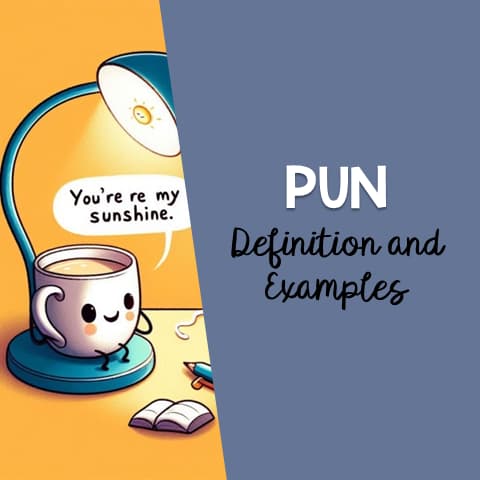
Here are 30 ready-to-use pun intended examples you can drop into conversation, social media, or writing — all clearly signposting the deliberate wordplay.
- The bakery business is on a roll (pun intended).
- I used to hate facial hair, but then it grew on me (pun intended).
- A plant grower’s success is rooted in patience and consistency (pun intended).
- The calendar was afraid because its days were numbered (pun intended).
- I am friends with all electricians. We have good current connections (pun intended).
- I told a chemistry joke, but there was no reaction (pun intended).
- The stadium got hot after the match. The fans left (pun intended).
- I am on a seafood diet. I see food and I eat it (pun intended).
- The bakery caught fire. The business is toast (pun intended).
- I stayed up all night wondering where the sun went. Then it dawned on me (pun intended).
- I used to be addicted to soap, but I am clean now (pun intended).
- She had a photographic memory but never developed it (pun intended).
- I’m reading a book on anti-gravity. It’s impossible to put down (pun intended).
- The bicycle couldn’t stand on its own because it was two-tired (pun intended).
- The dentist had a bad day. It was really pulling teeth (pun intended).
- I became a banker, but I lost interest (pun intended).
- The broken pencil was pointless (pun intended).
- I used to work at a belt factory, but it was a waist of time (pun intended).
- I’m reading a book about mazes. I got lost in it (pun intended).
- Time flies like an arrow. Fruit flies like a banana (pun intended).
- The wedding was so emotional even the cake was in tiers (pun intended).
- A pessimist’s blood type is always B-negative (pun intended).
- The coffee shop staff were so grounded (pun intended).
- I’m great at fixing stairs. I take them one step at a time (pun intended).
- The math teacher was very calculating (pun intended).
- The shoe thief was well-heeled (pun intended).
- The geologist was always on solid ground (pun intended).
- The electrician got a shock when he was fired (pun intended).
- The painter had a brush with the law (pun intended).
- The sailor had a lot of anchor management issues (pun intended).
Puns in Literature: Famous Examples
Puns are not just for jokes. Some of the greatest writers in history used them as serious literary tools, layering meaning and emotion into their language.
Shakespeare’s Puns
William Shakespeare used hundreds of puns across his plays and sonnets — more than any other author in the English language. His puns often appear in tragic moments, serving as dark comic relief or foreshadowing.
Famous Shakespeare puns:
- Romeo and Juliet — Mercutio, after being stabbed: “Ask for me tomorrow, and you shall find me a grave man.” (grave / serious, grave / burial site)
- Richard III — “Now is the winter of our discontent made glorious summer by this sun of York.” (sun / the literal sun, son / Richard’s brother, a son of the York family)
- Hamlet — The gravedigger scene: “I think it be thine, indeed, for thou liest in ‘t.” (liest / you are lying down, liest / you are telling lies)
- The Merchant of Venice — Multiple puns on “bond” — a financial bond, a physical bond, and a legal bond all coexist in the same scenes.
Shakespeare’s puns were calculated and deliberate — a true master class in pun intended definition in practice.
Lewis Carroll’s Puns
Lewis Carroll used puns to create the absurdist humor that defines Alice’s Adventures in Wonderland. His wordplay was central to the story’s logic-defying world.
- The Mouse speaks of “a long tail” — Alice hears “a long tale.” (tail / the animal’s tail, tale / a story)
- “We called him Tortoise because he taught us” — a homophonic pun on taught / tortoise.
- The Mock Turtle’s school subjects: Reeling, Writhing, and the different Branches of Arithmetic — Ambition, Distraction, Uglification, and Derision. (puns on Reading, Writing, Addition, Subtraction, Multiplication, and Division)
Oscar Wilde’s Puns
Oscar Wilde built an entire play around a single pun. The Importance of Being Earnest plays on the name Ernest (a man’s name) and earnest (meaning sincere and serious). The entire plot turns on this single wordplay.
- “I’ve now realized for the first time in my life the vital importance of Being Earnest.” — the final line of the play, resolving both meanings simultaneously.
- Wilde’s epigrams throughout his work frequently use homographic and homophonic wordplay to create irony.
Puns in Advertising and Marketing
Advertisers love puns because they make slogans unforgettable. A clever pun sticks in the memory far longer than a plain statement.
Famous advertising puns:
- “We’re on a roll” — used by bakery and food brands worldwide
- “Lawn and order” — used by garden and landscaping companies
- “A cut above the rest” — hair salons and butchers both use this
- “Time to get cracking” — egg brands and productivity apps
- “We’ve got you covered” — used by insurance, roofing, and clothing brands
- “Let’s taco ’bout it” — Mexican restaurant marketing campaigns
- “Seas the day” — travel and seafood brands
- “It’s a brew-tiful morning” — coffee brand campaigns
- “You’re un-beer-lievable” — craft beer labels
- “Curl up and dye” — humorous hair salon name
Advertising puns typically operate as homophonic or homographic puns, swapping expected words for sound-alike alternatives to create surprise and delight.
Puns in Social Media and Everyday Conversation
In modern communication, puns are the backbone of viral social media posts, memes, and caption culture. A well-placed pun gets likes, shares, and comments far above a plain statement.
Common social media pun patterns:
- Photo of a dog near a tree: “Just barking up the right tree (pun intended).”
- Post about a fitness journey: “I’ve been working on my core values (pun intended).”
- Coffee photo caption: “Espresso yourself (pun intended).”
- Travel post at the beach: “I’m shore about this life (pun intended).”
- Cat photo: “This is paw-sitively the best day ever (pun intended).”
- Book post: “I find reading quite novel (pun intended).”
- Music post: “I had a note-worthy day (pun intended).”
- Food post: “Life is gouda (pun intended).”
- Plant photo: “I’m rooting for you (pun intended).”
- Weather post: “Feeling like I’m on cloud wine (pun intended).”
How to Write a Good Pun
Writing effective puns is a skill that improves with practice. Here is a simple framework for crafting your own puns.
Step-by-step process:
- Choose a topic or subject you want to write about (food, animals, jobs, weather).
- List all the key words related to that topic.
- Find homophones (words that sound like yours but mean something else).
- Find homographs (words spelled the same but with a second meaning).
- Build a sentence that naturally uses both meanings at once.
- Test it — read it aloud. Does it get a groan or a laugh? Both are good.
- Add “pun intended” in parentheses if you want to flag it deliberately.
Examples of the process in action:
- Topic: baking → key word: dough → homophone: “do” → pun: “I knead you in my life (pun intended).”
- Topic: music → key word: note → homograph: musical note / written note → pun: “That performance hit all the right notes (pun intended).”
- Topic: cats → key word: paw → compound: paw / pause → pun: “I need to give this some paws for thought (pun intended).”
When to Use “Pun Intended” and When to Avoid It
Knowing when to deploy the phrase is just as important as the pun itself.
Use “pun intended” when:
- You want to make sure your audience catches the joke.
- The pun is subtle and might go unnoticed without flagging.
- You are writing for a casual, friendly, or humorous audience.
- You are posting on social media where humor drives engagement.
- You want to add a self-aware, witty tone to your writing.
Avoid “pun intended” when:
- You are writing in a formal or academic context.
- The document is professional — a report, legal brief, or official email.
- Your audience may not appreciate or understand the wordplay.
- Explaining the pun would kill the humor entirely.
- The pun is already so obvious that pointing it out is unnecessary.
As a general rule: the best puns don’t need to be explained. Adding “pun intended” works when you want acknowledgment, not explanation.
Puns Across Different Languages
Puns exist in virtually every language, but they rarely translate across linguistic boundaries. This is because they depend on the specific sound patterns and multiple meanings that are unique to each language.
- In Chinese, puns often rely on tones — the same syllable with different tones can have entirely different meanings.
- In French, puns called “calembours” are a respected form of literary humor.
- In Japanese, wordplay called “dajare” is a staple of comedy and children’s entertainment.
- In Arabic, classical literature is full of punning verse known as “tajnis.”
- In Sanskrit, ancient texts use a form of pun called “slesha” — a single verse with multiple simultaneous meanings.
This is why pun intended definition in English is specifically rooted in the English language’s rich supply of homophones and homographs — a structural feature that makes English one of the most pun-friendly languages in the world.
Common Mistakes When Using Puns
Understanding what not to do is just as valuable as learning what to do.
- Over-explaining — if you have to explain why it is funny, the pun did not land. Let it breathe.
- Forced wordplay — if the sentence sounds awkward just to fit a pun, it loses its effect.
- Using puns at inappropriate moments — in a serious professional email, a pun can undermine trust.
- Stacking too many puns — unless you are going for a compound pun effect, one pun per sentence is the rule.
- Missing the double meaning — some writers think they have written a pun but only one meaning works. Test both.
- Ignoring your audience — a pun that requires specific cultural knowledge will fall flat if your audience doesn’t share that reference.
- Forgetting context — a pun that works perfectly in writing may not land when spoken, and vice versa.
Pun Intended in Pop Culture
The phrase pun intended and the use of deliberate wordplay is deeply embedded in popular culture across films, TV, and celebrity quotes.
- James Bond films frequently use punny one-liners after defeating a villain — deliberate wordplay tied to how the villain was defeated.
- The TV show Brooklyn Nine-Nine uses pun-based humor as a character trait for Jake Peralta.
- Newspaper headline writers are famous for puns — especially in British tabloids.
- Late-night talk show hosts use pun intended frequently when commenting on the news.
- The phrase appears thousands of times per day on Reddit, Twitter, and Instagram as users flag their own deliberate wordplay.
- Comedy podcasts and stand-up comedians use “pun intended” to acknowledge groan-worthy jokes before the audience groans.
- In advertising copy, pun intended sometimes appears explicitly in print campaigns to create a self-aware, modern brand voice.
Frequently Asked Questions (FAQs)
What is the pun intended definition in simple terms?
Pun intended means a wordplay joke was made deliberately, and the speaker wants you to notice it. It signals that the double meaning in a sentence was placed there on purpose, not by accident.
What is the difference between pun intended and no pun intended?
Pun intended flags a deliberate joke, while no pun intended claims the wordplay was accidental. However, no pun intended is often used sarcastically — when the pun was very much on purpose.
What is a homophonic pun?
A homophonic pun uses two words that sound the same but have different meanings and spellings. Example: “I used to work at a belt factory, but it was such a waist of time.” (waist / waste)
What is a homographic pun?
A homographic pun uses one word that is spelled the same but carries two different meanings. Example: “A boiled egg every morning is hard to beat.” (hard / difficult, hard / firm in texture)
What is a compound pun?
A compound pun is a sentence that contains more than one pun at the same time. Example: “Never scam in the jungle — cheetahs are always spotted.” (cheaters / cheetahs, spotted / caught, spotted / the animal’s markings)
What is paronomasia?
Paronomasia is the technical or academic term for a pun. It comes from the Greek words meaning “to make a change in a name” and refers to any deliberate use of words with similar sounds or multiple meanings for rhetorical or comic effect.
Did Shakespeare use puns?
Yes, extensively. Shakespeare used hundreds of puns across his plays and sonnets. His most famous include Mercutio’s “grave man” pun in Romeo and Juliet and the “sun of York / son of York” pun in the opening of Richard III.
Is a pun the same as a play on words?
Yes, a pun and a play on words are the same thing. Both refer to the deliberate use of a word’s double meaning or a word’s similarity in sound to another word in order to create humor or rhetorical effect.
When should you not use “pun intended”?
Avoid it in formal writing, professional emails, academic papers, or legal documents. The phrase is conversational and humorous, and using it in serious contexts can undermine your credibility or tone.
Can puns be used in advertising?
Yes — puns are one of the most powerful tools in advertising copy. They make slogans memorable and shareable. Classic examples include “We’ve got you covered” for insurance brands and “A cut above the rest” for salons and butchers.
Conclusion
Pun intended definition comes down to one clear idea — deliberate, purposeful wordplay that demands to be noticed.
Whether it’s a homophonic pun swapping a word for its sound-alike, a homographic pun playing two meanings off the same spelling, or a compound pun stacking multiple jokes in one sentence, puns are a rich and powerful part of the English language.
From Shakespeare to social media captions, pun intended signals wit, creativity, and linguistic confidence. Understanding the types, uses, and history of puns in 2026 makes you a sharper reader, a more engaging writer, and a much more dangerous person in any group chat.