What Are Puns? Meaning, Types, and Examples 2026
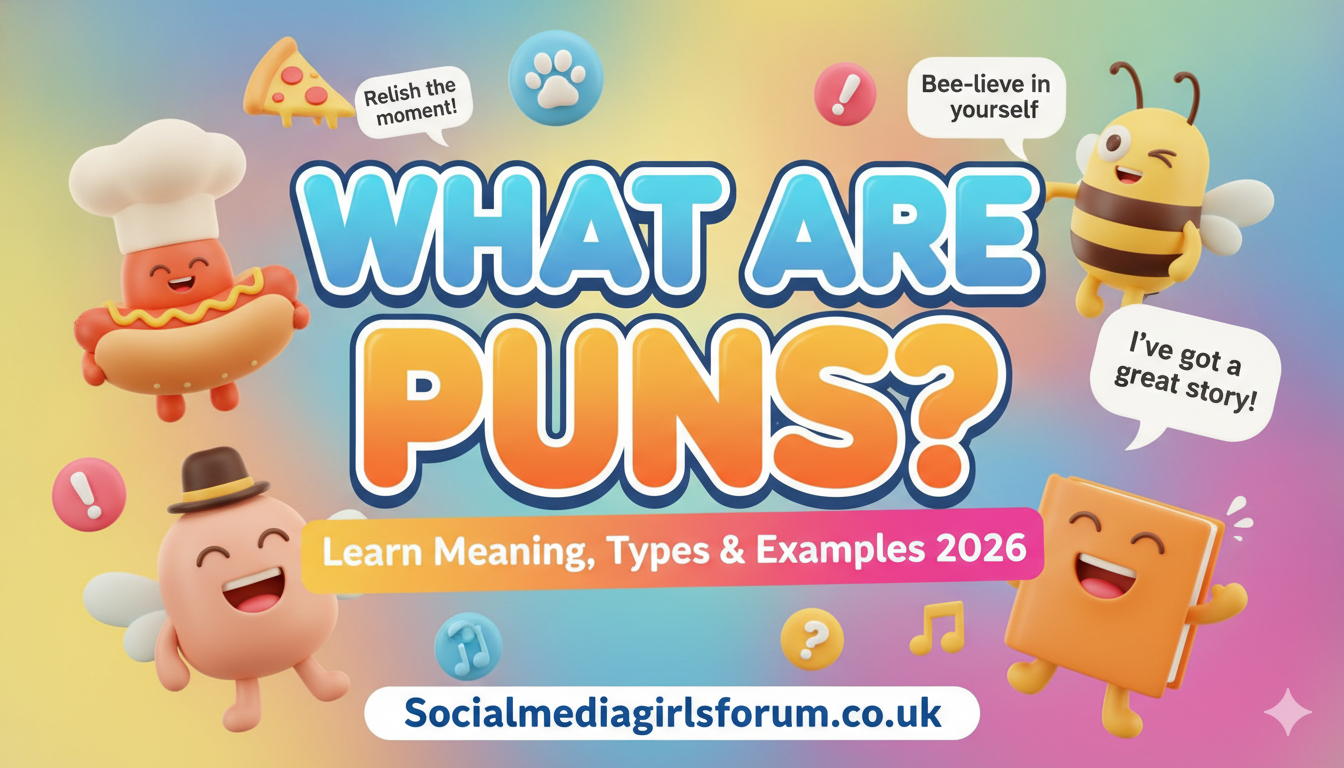
What are puns? A pun is a form of wordplay that uses a word’s multiple meanings or its similarity in sound to another word to create a humorous or clever effect.
Also known as paronomasia, puns have been a staple of human language for thousands of years — from ancient Greek theatre to Shakespeare’s plays to modern advertising slogans.
Whether you love them or groan at them, puns are everywhere.
What Is a Pun? — Simple Definition
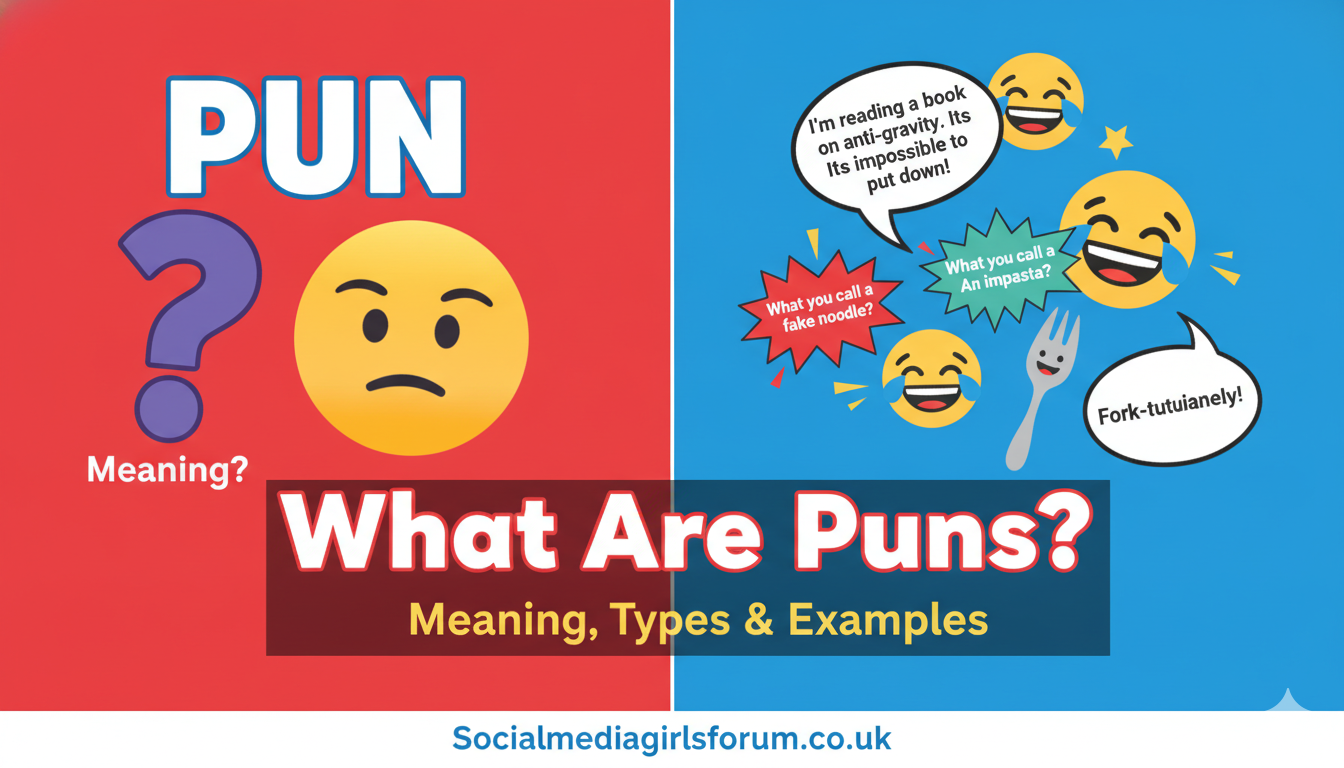
A pun is a joke or clever phrase that plays on the double meaning of a word or on two words that sound very similar. The goal is usually to create humor, surprise, or a clever twist in meaning.
The technical term for a pun is paronomasia, which comes from the Greek word “paronomazein,” meaning “to make a change in a name.” The word “pun” itself is believed to have originated in the 17th century from the Italian word “puntiglio,” meaning a fine or subtle point.
A simple example: “I used to be a banker, but I lost interest.” Here, “interest” carries two meanings — financial interest and personal enthusiasm — and the joke works because both meanings apply.
Why Are Puns Called the Lowest Form of Humor?
Puns have a reputation as groan-worthy jokes — often called “dad jokes” — and many people jokingly refer to them as the lowest form of humor.
The reason is that puns are so obvious once you spot them. The moment the double meaning clicks, the joke feels almost too simple. This predictability is exactly what triggers the groan.
But many linguists and comedians argue the opposite — that crafting a truly clever pun requires a deep understanding of language, context, and timing. A well-built pun is actually a sign of linguistic intelligence.
How Do Puns Work? — The Linguistics Behind It
Puns work because the English language (and many others) is full of words that share sounds or spellings but carry different meanings. This natural ambiguity in language is what makes punning possible.
When you hear or read a pun, your brain processes two meanings simultaneously. This momentary cognitive overlap — recognizing both meanings at once — is what creates the humor. It is a surprise that your brain resolves instantly.
Puns exploit three main linguistic features: homophones (same sound, different meaning), homographs (same spelling, different meaning), and homonyms (same spelling and sound, different meaning).
All Types of Puns — Explained With Examples
Understanding pun types makes it much easier to spot them in everyday speech, literature, and advertising. Here is a breakdown of every major type.
Homophonic Puns
Homophonic puns use words that sound the same but have different meanings and often different spellings. These are also called homophones.
These puns work especially well in spoken form because the listener cannot see the spelling — only the sound. The double meaning hits harder in conversation.
Examples:
- “The wedding was so emotional, even the cake was in tiers.” (tiers / tears)
- “I scream for ice cream!” (I scream / ice cream)
- “Denial is not just a river in Africa.” (Denial / Da Nile)
Homographic Puns
Homographic puns use words that are spelled the same but have different meanings — and sometimes different pronunciations. These work especially well in written form.
A reader sees the same word but realizes it carries two entirely different meanings depending on context. This creates a moment of pleasant confusion that resolves into humor.
Examples:
- “A boiled egg every morning is hard to beat.” (hard to beat = difficult / beat an egg)
- “I don’t know how to polish shoes; I’m not from Poland.” (polish = shine / Polish = nationality)
- “Time flies like an arrow; fruit flies like a banana.” (flies = moves fast / flies = insects)
Homonymic Puns
Homonymic puns use words that are both spelled and pronounced the same but carry different meanings. These are true homonyms.
This is the most common type of pun in everyday speech. The same word does double duty — meaning two things at once within the same sentence or joke.
Examples:
- “I made a joke during the Zoom call, but it wasn’t remotely funny.” (remotely = slightly / remote = online)
- “One hundred hares escaped from the zoo, so police are combing the area.” (hares = rabbits / hairs; combing = searching / combing hair)
- “Bark is worse than his bite.” (bark = dog sound / tree bark)
Compound Puns
Compound puns stack two or more puns into a single sentence. They are more complex and require the listener to catch multiple layers of wordplay at once.
These are considered the most impressive puns because they demand both linguistic creativity from the writer and sharp attention from the reader or listener.
Examples:
- “When the clock factory caught fire, all the employees tocked out.” (tocked = talked / ticked-tocked)
- “One hundred hares have escaped from the zoo, so police are combing the area.” (hares/hairs + combing/searching)
Visual Puns
Visual puns use images or arrangements — rather than just words — to play with meaning. They are common in advertising, graphic design, comic strips, and logos.
You have likely seen visual puns in brand logos where the shape of an object doubles as a letter or symbol. They are a staple of creative marketing because they are memorable and attention-grabbing.
Examples:
- A barbershop sign showing a comb with the tagline “We make the cut”
- Movie posters that use visual double meanings in the imagery
- Logos where a negative space creates a hidden shape (like the FedEx arrow)
Recursive Puns
Recursive puns have two parts — and the second part only makes sense if you already understand the first. They require background knowledge or cultural context to land properly.
These are the most niche type of pun and often the most satisfying when they work. The extra layer of understanding makes the payoff feel earned.
Examples:
- “May the fourth be with you.” (requires knowledge of Star Wars’ “May the force be with you”)
- “Resistance is futile, if less than one ohm.” (requires basic electronics knowledge)
Quick Reference Table — Types of Puns
| Pun Type | Based On | Works Best In | Example |
|---|---|---|---|
| Homophonic | Same sound, different spelling/meaning | Spoken language | “tiers” / “tears” |
| Homographic | Same spelling, different meaning | Written language | “flies” (verb / insect) |
| Homonymic | Same spelling and sound, different meaning | Both spoken and written | “remotely funny” |
| Compound | Two or more puns combined | Both spoken and written | “combing the area” |
| Visual | Images with double meaning | Design, advertising | Logos, comic strips |
| Recursive | Requires prior knowledge | Niche audiences | “May the fourth be with you” |
Puns vs Similar Literary Devices
Puns are sometimes confused with other forms of wordplay. Knowing the difference helps you understand and use them more precisely.
Pun vs Double Entendre
A double entendre is a specific type of pun where one meaning has a slightly indecent or sexual connotation. All double entendres are puns, but not all puns are double entendres. The key difference is intent and the nature of the second meaning.
Pun vs Irony
Irony involves saying the opposite of what you mean. A pun plays on double meanings within the same word or phrase. They can overlap — a pun can be ironic — but they are distinct devices.
Pun vs Metaphor
A metaphor replaces one concept with another entirely. A pun keeps both meanings present simultaneously. The humor in a pun comes from the collision of two meanings, not from substitution.
Comparison Table
| Device | How It Works | Example |
|---|---|---|
| Pun | Two meanings of one word/sound | “I lost interest” |
| Double Entendre | Pun with an indecent meaning | Context-dependent |
| Irony | Saying the opposite | “What lovely weather” (in a storm) |
| Metaphor | One thing stands for another | “Life is a journey” |
Puns in Literature — A Deep Dive
Puns have appeared in literature for thousands of years. They are not just jokes — they serve serious literary purposes including character development, irony, and thematic depth.
Puns in Shakespeare
William Shakespeare is widely considered the greatest punster in the history of English literature. His plays are packed with wordplay on multiple levels — from light comedy to dark irony.
In Romeo and Juliet, the dying Mercutio says: “Ask for me tomorrow, and you shall find me a grave man.” Here, “grave” means both serious and a burial place — a dark, tragic pun delivered in his final moments.
In Richard III, Shakespeare opens with: “Now is the winter of our discontent made glorious summer by this sun of York.” The word “sun” is also “son” — referring to Richard as a son of the House of York. The pun carries deep political meaning about power and lineage.
In Hamlet, when Hamlet is asked where he has hidden Polonius’s body, he replies that Polonius is “at supper — not where he eats, but where he is eaten.” The pun on supper is darkly comic and chilling at once.
In Two Gentlemen of Verona, Shakespeare plays with “tide” and “tied” in a long exchange between characters — stacking the pun across multiple lines for sustained comic effect.
Puns in Ancient Literature
Puns are not a modern invention. Ancient Greek playwrights like Aristophanes used wordplay in comedic works. Roman writers including Plautus built puns into their theatrical scripts.
The Bible also contains wordplay — in Hebrew, the name “Adam” relates to the Hebrew word for “earth” (adamah), and “Eve” connects to the word for “living.” These are considered early examples of meaningful, intentional name-based puns.
Puns in Modern Literature and Media
Modern authors use puns deliberately for tone, surprise, and depth. In Finding Nemo, Marlin uses “fronds” (large leaves) and “anemones” (sea plants) in place of “friends” and “enemies” — a layered visual and linguistic pun.
Terry Pratchett, the beloved fantasy author, built his entire Discworld series on a foundation of multilayered puns, wordplay, and satirical humor. His puns work on both surface and philosophical levels.
Puns in Advertising and Marketing
Puns are one of the most powerful tools in advertising. They are memorable, shareable, and create an emotional connection with the audience through humor.
A clever pun in a headline makes readers pause, think, and smile — which increases the time they spend with the ad and improves recall. Brands use puns in slogans, product names, billboards, and social media campaigns.
Examples from advertising:
- A plumber’s van: “We’re the last plumbers you’ll ever need — unless you screw it up yourself”
- A gym tagline: “Our equipment is outstanding in its field”
- A dental clinic: “Brace yourself for a great smile”
- A bakery: “You knead us”
These examples work because they are industry-specific — the double meaning connects directly to the product or service being sold, making the brand instantly more memorable.
Puns in Everyday Conversation — Dad Jokes
The most common form of puns in everyday life is the “dad joke.” This term refers to simple, often groan-inducing puns that are obvious and predictable — but lovable for exactly that reason.
Dad jokes have become a cultural staple across the world. They are used to break the ice, lighten the mood, and create quick moments of shared laughter. The groan they produce is as much a part of the fun as the laugh.
Classic dad joke puns:
- “Why don’t scientists trust atoms? Because they make up everything.”
- “What do you call a bear with no teeth? A gummy bear.”
- “I told my doctor I broke my arm in two places. He told me to stop going to those places.”
- “Did you hear about the mathematician who’s afraid of negative numbers? He’ll stop at nothing to avoid them.”
- “My boss asked if I’m good with PowerPoint. I said I Excel at it.”
How to Write a Good Pun — Tips for Beginners
Writing effective puns is a skill. It takes practice, pattern recognition, and a good ear for language. Here are practical steps to get started.
Step 1 — Pick a Topic or Word
Start with a word or concept that has multiple meanings, or that sounds like another word. Common areas to mine: jobs, food, animals, numbers, and actions.
Think of words that do double duty — like “interest,” “charge,” “pitch,” “light,” or “bark.” These are goldmines for pun-writing.
Step 2 — Find the Double Meaning
Look for the second meaning of your chosen word. Ask yourself: what else could this word mean in a completely different context?
If your word is “fired,” it can mean being dismissed from a job or something being shot from a gun. Both meanings can fuel a pun in the right sentence.
Step 3 — Build the Setup
Write a sentence or short story that sets up one meaning naturally. The setup should feel normal — the punchline is where the second meaning sneaks in.
The best puns feel almost accidental. The reader or listener should not see the double meaning coming until the final word or phrase lands.
Step 4 — Test It Out Loud
Puns — especially homophonic ones — need to be heard to work fully. Read your pun aloud and see if the sound of the words creates the intended confusion and recognition.
If someone groans and smiles at the same time, you have done your job. That is the gold standard reaction for a successful pun.
Pun Examples List — 30 Puns Across Different Categories
Here is a large collection of puns organized by category to show how versatile wordplay can be.
Food Puns
- “I’m on a seafood diet. I see food and I eat it.”
- “The baker told a great joke — it was on a roll.”
- “Lettuce celebrate — we make a great pear.”
- “I’m reading a book about cheese. It’s grate.”
- “The egg won the argument — it just cracked under pressure.”
Animal Puns
- “What do you call a sleeping dinosaur? A dino-snore.”
- “I used to hate facial hair, but then it grew on me.”
- “Why don’t elephants use computers? They’re afraid of the mouse.”
- “What do you call a fish without eyes? A fsh.”
- “That bear joke was un-bear-able.”
Work and Career Puns
- “I’m reading a book about anti-gravity — it’s impossible to put down.”
- “I got a job at a bakery because I kneaded the dough.”
- “The calendar’s days are numbered.”
- “I used to work at a shoe recycling shop. It was sole-destroying.”
- “My resume is just a list of things I hope you never ask me to do.”
Math and Science Puns
- “I would tell you a chemistry joke but I know I wouldn’t get a reaction.”
- “Did you hear about the chemist who was reading a book about helium? He couldn’t put it down.”
- “Without geometry, life is pointless.”
- “I asked the math teacher if I could go to the bathroom. She said, ‘I’ll give you a number.'”
- “Parallel lines have so much in common — it’s a shame they’ll never meet.”
Miscellaneous Puns
- “Time flies like an arrow. Fruit flies like a banana.”
- “I used to hate clocks. Now I’ve come around.”
- “The bicycle could not stand on its own because it was two-tired.”
- “A bicycle can’t stand on its own because it is two-tired.”
- “I stayed up all night to see where the sun went. Then it dawned on me.”
Puns Across Different Languages
Puns are not limited to English. Almost every language has its own tradition of wordplay, because all languages have words with multiple meanings or similar sounds.
In Japanese, the word for “four” (shi) also sounds like the word for “death,” making it a source of both superstition and wordplay. In French, wordplay on sounds is a staple of comedy. In Hindi and Urdu, double-meaning humor (called “shayari” in some contexts) is deeply embedded in poetry and casual speech.
This universality shows that puns are not just a trick of the English language — they are a fundamental feature of human communication and humor across cultures.
Why Puns Matter — Their Purpose and Value
Puns are more than just jokes. They serve several important functions in language and communication.
They build vocabulary by forcing people to think about multiple meanings of words. Students who engage with puns tend to develop stronger word association skills and language flexibility.
They make content more memorable. A well-placed pun in a headline, title, or speech creates a moment of surprise that sticks in the memory far longer than a plain statement.
They create connection and warmth. A shared laugh over a pun — even a bad one — builds rapport between people instantly. This is why puns are so useful in public speaking, teaching, and customer-facing communication.
Puns in Education
Teachers have used puns for decades as a tool for vocabulary building, creative writing, and language exploration. Puns require students to think about more than one meaning at once, which develops higher-order thinking skills.
In English grammar classes, studying puns introduces students to homophones, homographs, and homonyms in a fun and engaging way. It makes what could be dry vocabulary lessons memorable and enjoyable.
Many standardized English exams around the world include questions that test a student’s ability to understand double meanings and wordplay — making puns a genuinely useful area of study.
Frequently Asked Questions (FAQs)
What are puns in simple words?
A pun is a joke that plays on the double meaning of a word or two words that sound alike. It creates humor by making the reader or listener think of two meanings at once.
What is the technical name for a pun?
The technical term for a pun is “paronomasia.” It comes from the Greek word “paronomazein,” which means to make a change in a name.
What are the main types of puns?
The main types are homophonic, homographic, homonymic, compound, visual, and recursive puns. Each type exploits a different feature of language to create wordplay.
What is a homophonic pun?
A homophonic pun uses words that sound the same but have different meanings or spellings. Example: “The wedding was in tiers” (tiers/tears).
What is the difference between a pun and a double entendre?
A double entendre is a type of pun where one meaning is slightly indecent. All double entendres are puns, but not all puns are double entendres.
Are puns a literary device?
Yes, puns are a recognized literary device used by authors to add humor, irony, ambiguity, or depth to writing. Shakespeare used them extensively in his plays and sonnets.
Why do puns make people groan?
Puns cause groans because they are obvious once spotted — the double meaning clicks too quickly, making the joke feel almost too simple. The groan is a universal, affectionate reaction to this “predictable cleverness.”
How do you write a good pun?
Start with a word that has multiple meanings or sounds like another word. Build a sentence that sets up one meaning naturally, then let the second meaning land as the punchline. Test it out loud.
What is a compound pun?
A compound pun combines two or more puns in a single sentence. Example: “Police are combing the area” (combing = searching + hares/hairs).
Are puns used in advertising?
Yes, puns are widely used in advertising because they are memorable, shareable, and create an emotional connection through humor. Clever wordplay in slogans and headlines improves brand recall significantly.
Conclusion
What are puns? They are one of the most creative and enduring tools in the English language — a way to squeeze two meanings into a single word and make people think, smile, or groan.
From the tragic wordplay of Shakespeare to the cheerful groan of a dad joke, puns have held a unique and irreplaceable place in human communication for centuries. They build vocabulary, sharpen language skills, create memorable content, and bring people together through shared humor.
Whether you are a student studying for an English exam, a writer looking to add wit to your work, or just someone who wants to tell a better joke — understanding puns gives you a genuine edge with language. Puns are not the lowest form of humor. When done right, they are the highest form of wordplay.